
 by CompTech International
Guide
How to Work Out the Cost and Profit of Each Tour
A tour makes money only when its price covers all its costs: hotels, vehicles, guides, permits and flights. Work out the cost per person and for the group, and keep each tour's income and costs apart.
Why work out the profit of each tour
Your profit and loss account shows the whole business, not each tour. A good month can hide a trek that lost money.
When you know each tour's profit, you can see:
- which routes, seasons and agents earn the most;
- which quotes were too low;
- whether a discount for a small group was worth it;
- which suppliers cost more than you planned.
Per person costs and group costs
- Per person (variable) costs grow with each guest: domestic flights, permits and entry fees, lodge beds and meals.
- Group (fixed) costs stay the same for 2 guests or 12: the guide, the vehicle, and the guide's own food, lodging and flight.
Some costs move in steps, such as one porter for every two guests. Treat them as group costs, and check the step for each group size.
The cost of one guest is the per person costs, plus the group costs divided by the number of guests. A smaller group costs more for each guest, so quote a price for a set group size and a higher price for smaller groups.
What goes into a tour's cost
- Hotels and lodges: rooms, and meals if not included.
- Vehicles: hire, fuel and the driver's allowance.
- Guides and porters: wages, food, lodging, insurance and travel to the start.
- Permits and entry fees: trekking permits, park and conservation area fees, and site tickets.
- Flights: domestic flights for guests and staff, and extra baggage.
- Small costs: airport pickups, a welcome dinner, drinking water, bank charges on foreign payments, and commission to the agent who sent the group.
If you can claim back the VAT on a supplier's bill, use the amount before VAT. Ask your auditor which bills this applies to.
A worked example: a 7-day trek for 6 guests
A group of 6 guests books a 7-day trek from Pokhara, 2 to 8 Mangsir 2083, with flights from Kathmandu and back. You charge NPR 62,000 for each guest. All amounts are before VAT.
| Cost | Worked out as | NPR |
|---|---|---|
| Flights, Kathmandu to Pokhara and back | 9,000 × 6 guests | 54,000 |
| Permits and entry fees | 3,000 × 6 guests | 18,000 |
| Lodges, 6 nights | 1,500 × 6 nights × 6 guests | 54,000 |
| Meals, 7 days | 2,000 × 7 days × 6 guests | 84,000 |
| Per person costs | 35,000 a guest | 2,10,000 |
| Guide | 3,000 × 7 days | 21,000 |
| Guide's food, lodges and flight | For the whole trek | 25,000 |
| Porters, 1 for every 2 guests | 3 porters × 2,000 × 7 days | 42,000 |
| Jeep to and from the trail | For the whole trek | 12,000 |
| Group costs | 1,00,000 | |
| Total cost | 3,10,000 | |
| Price charged | 62,000 × 6 guests | 3,72,000 |
| Profit | 62,000 |
With 6 guests the tour costs NPR 3,10,000, or NPR 51,667 for each guest. The profit is NPR 62,000, about 17% of the price.
If only 4 guests book at the same price, per person costs fall to NPR 1,40,000. Group costs fall only to NPR 86,000, because you need two porters instead of three. The total cost is NPR 2,26,000, or NPR 56,500 for each guest. Income is NPR 2,48,000, so the profit drops to NPR 22,000. Two fewer guests cut the profit by almost two thirds.
Keep each tour's income and costs apart
Give each tour its own cost centre, with a name you can find later, such as "Pokhara trek, 6 guests, Mangsir 2083". Put it on every document for the tour: invoices, supplier bills, receipts, payments and journals. Its report then shows the tour's own income, costs and profit.
- Use groups. Put each tour under a parent, such as a season or a product, that adds them up.
- Keep office costs out. Office rent, office salaries and marketing are overheads, not the cost of one tour.
- Code the deposits too. Put the cost centre on each deposit receipt.
Supplier bills that arrive after the tour
Lodges, guides and vehicle owners often send their bills weeks after the group is home. If you count the profit before they arrive, the tour looks better than it was.
- Keep your costing sheet. Tick each cost when its bill arrives.
- Ask the supplier for any bill that is missing.
- Enter each late bill with the same cost centre, even in a later month.
If you must report before a bill arrives, for example at month end or at year end in Ashadh, record an estimate of the cost. This is an accrual. Say the jeep owner has not billed the NPR 12,000 by the end of Mangsir:
| Account | Debit (NPR) | Credit (NPR) |
|---|---|---|
| Tour costs: vehicles (Pokhara trek) | 12,000 | |
| Accrued expenses | 12,000 |
When the real bill comes, reverse this entry and enter the bill.
Closing a tour
- Check that every supplier's bill is entered or accrued.
- Check that every invoice to the customer is made, with any refund as a credit note.
- Compare the actual costs with your costing sheet, and use what changed in your next quote.
- Stop new costs on the tour, but keep it open for the customer's last payment.
- When all the money is in, close the tour for good.
Doing this in CAS360
Cost centres are on every plan.
- A cost centre for each tour, with its dates, under a parent that adds them up.
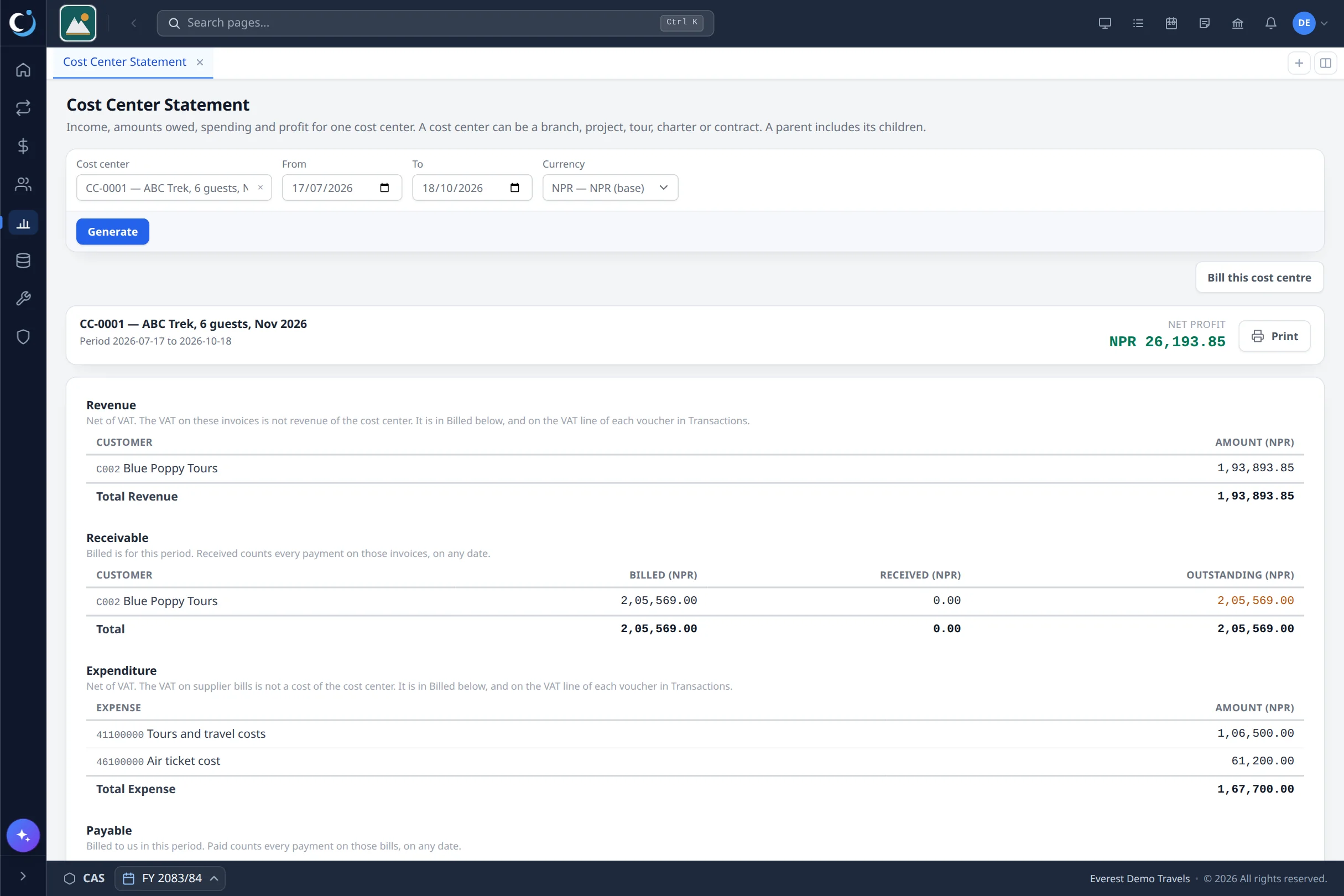
- Cost Center Statement. One tour's revenue, receivable, expenditure, payable, profit, money flow, movement and transactions.
- Closing. A provisionally closed tour takes receipts only, so the last payment can still come in. Close it this way after the supplier bills are in, or close it for good. Closing a parent closes the tours under it.
- Tour package lines. A PKG- number, the traveller, the dates, and taxable and non-taxable amounts. On every plan, on request.
- Quotes and budgets. The tour quote, tour budget and profit-per-tour screens are part of projects (Enterprise plan).
Read more about the Free plan, CAS360 for travel agencies and all plans and prices.
Questions
Questions about tour costing
What is a cost centre?
A label you put on every entry for one part of your business, such as a tour, a branch or a vehicle. Its report shows that part's own income, costs and profit.
Should I price a tour per person or for the whole group?
Work out both, then add your margin. Quote for a set group size, because a smaller group costs more for each guest.
Where do office rent and salaries go?
Keep them out of each tour, as overheads. The profit from all your tours together must cover them.
A lodge bill came after I worked out the profit. What now?
Enter it against the same tour, even in a later month. When you know a bill is coming, record an accrual so the profit is right sooner.
Can I see each tour's profit in CAS360 without the Enterprise plan?
Yes. On every plan, the Cost Center Statement shows each tour's revenue, costs and profit.