
 by CompTech International
Guide
What IRD-Compliant Billing Means for Your Accounting Software
IRD-compliant software makes VAT bills with the details IRD asks for, numbers them in order, keeps cancelled bills and marks reprints as copies. It also keeps the sales and purchase books, and works in Bikram Sambat dates.
What "IRD-compliant" means
The Inland Revenue Department (IRD) sets the rules for VAT bills and for billing software. IRD-compliant software follows them, and your auditor still checks the records.
IRD changes its rules from time to time. For a specific rule, check the current IRD directive or ask your auditor.
1. A VAT bill with the right details
A VAT bill, or tax invoice, usually shows:
- your business name, address and PAN;
- the buyer's name and address, and the buyer's PAN where it is needed;
- the bill number and the date;
- what was sold, with quantity, rate and amount;
- the taxable amount, the VAT at 13% and the total.
IRD sets the exact list, and when the buyer's PAN must appear.
For example, on 15 Kartik 2083 you sell 10 units at NPR 4,500 each to Himal Traders on credit. The taxable amount is NPR 45,000, VAT at 13% is NPR 5,850, and the bill total is NPR 50,850:
| Account | Debit (NPR) | Credit (NPR) |
|---|---|---|
| Himal Traders (customer) | 50,850 | |
| Sales | 45,000 | |
| VAT payable | 5,850 |
When a bill has taxable and non-taxable amounts, the software should keep them in separate columns. Ask your auditor which items are non-taxable.
2. Bill numbers in order
Bills should be numbered in order, with no number used twice or missing. The software should give the number, and nobody should be able to change it later.
If a draft takes a number and is then thrown away, a gap opens. Good software gives the number only when the bill is approved. Ask your auditor how numbering should work across fiscal years and branches.
3. Cancelled bills are kept
Do not delete a wrong bill. Mark it cancelled: it keeps its number and stays in the sales book. Then issue a new, correct bill.
When goods come back, or the price is cut after the sale, the usual way is a credit note against the first bill. Say Himal Traders returns 2 of the 10 units. The credit note is NPR 9,000 plus VAT of NPR 1,170, so NPR 10,170 in all:
| Account | Debit (NPR) | Credit (NPR) |
|---|---|---|
| Sales returns | 9,000 | |
| VAT payable | 1,170 | |
| Himal Traders (customer) | 10,170 |
4. Reprints are marked as copies
When a customer loses the original tax invoice, you print a copy. The software should print the first one as the tax invoice and mark every later print as a copy, so a copy never looks like a second original.
5. The sales book and the purchase book
A VAT-registered business keeps a sales book and a purchase book. They list every bill: number, date, party, PAN, taxable amount and VAT. Your VAT return is built from their totals.
The software should make these books from your bills, in the format IRD asks for now.
In the example for Kartik 2083, the sales book shows VAT of NPR 5,850 on the sale, less NPR 1,170 on the credit note: NPR 4,680. The purchase book shows a purchase of NPR 20,000 with VAT of NPR 2,600. The VAT to pay is 4,680 − 2,600 = NPR 2,080. Ask your auditor which purchase VAT you may claim.
6. Bikram Sambat dates and the fiscal year
Bills in Nepal carry Bikram Sambat (BS) dates. Fiscal year 2083/84 runs from 1 Shrawan 2083 to the last day of Ashadh 2084.
BS months do not match AD months. The software should take BS dates, close each month on the BS month end, and show the AD date beside it for foreign customers and banks.
7. IRD's electronic billing system (CBMS)
CBMS (Central Billing Monitoring System) is IRD's electronic billing system. Billing software sends the bills to it. IRD decides which businesses must use it, and from when.
Once IRD has a bill, your copy and IRD's copy must stay the same. So the software should stop edits to a sent bill. You correct it with a credit note, or a cancellation where the rules allow it.
Ask the provider: Does the software send bills by itself, or do you send them? Does it show IRD's answer for each bill? What happens when IRD's server does not answer?
Common mistakes
- Deleting a wrong bill and using its number again.
- Printing a second "original" when a customer loses the first.
- Keeping the sales book in Excel, apart from the bills.
- Closing a month on the AD date instead of the BS month end.
- Thinking compliant software replaces your auditor.
IRD billing in CAS360
CAS360 is IRD compliant and ISO 9001:2015 aligned. On every plan, Free included:
- The first print of a bill says "Tax Invoice". Every later print says "Copy of Original".
- A cancelled bill is marked cancelled and keeps its entries. It is never deleted.
- With approvals turned on, a bill gets its number only when it is approved.
- Credit and debit notes, including a refund of less than the bill.
- VAT registers in IRD's format, and Anusuchi 5 and 6.
- Bikram Sambat dates, with AD beside them.
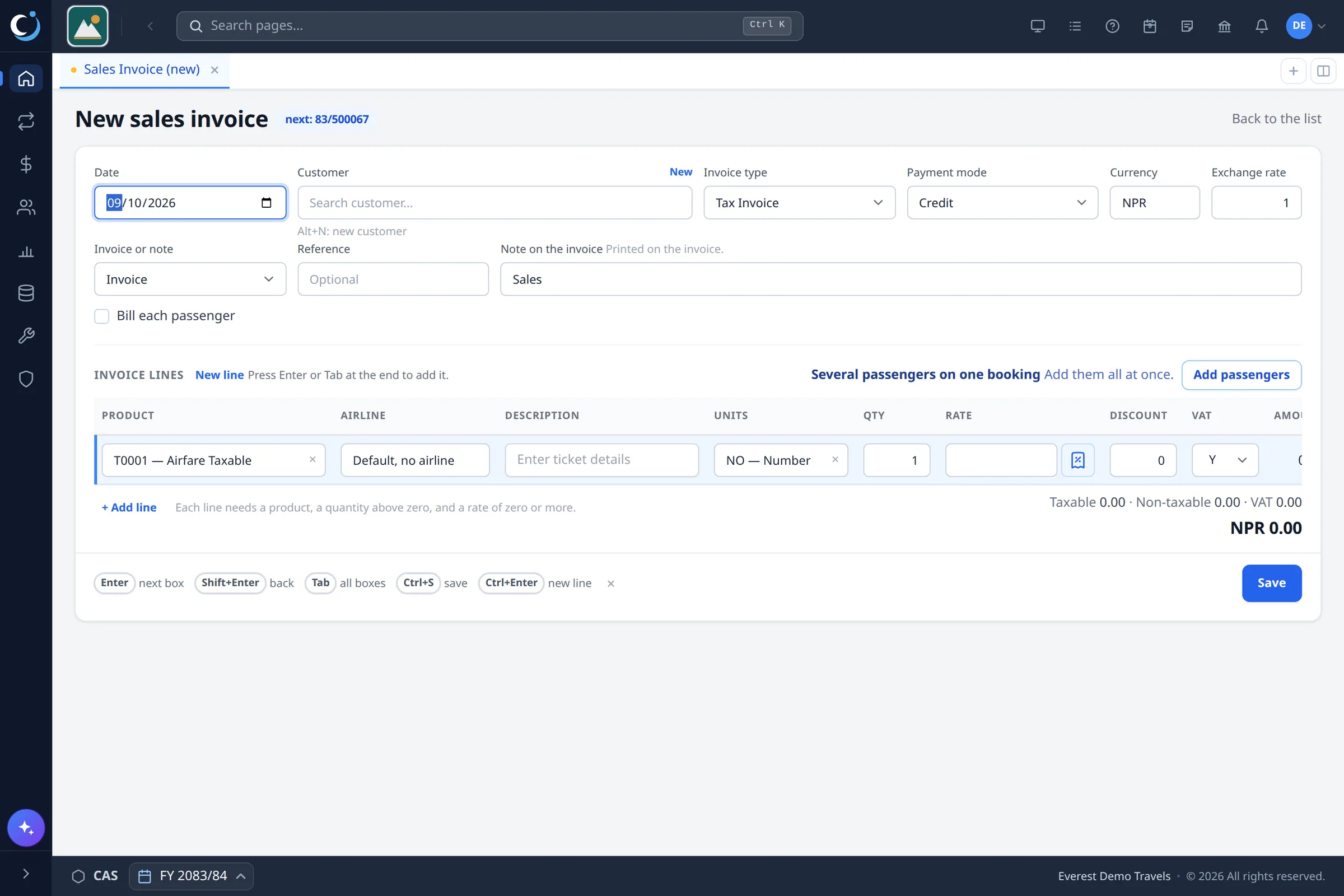
Editing an issued bill. Without IRD e-billing, an issued bill can be edited. Paid plans record the edit in the audit trail; Free has no audit trail. With IRD e-billing (CBMS, Enterprise plan), an issued bill can only be cancelled or credited. A bill already filed with IRD can only be credited.
See the Free plan and all plans and prices.
Questions
Questions about IRD billing
What does IRD-compliant billing software mean?
It follows IRD's rules for VAT bills: the details on each bill, numbers in order, cancelled bills kept, copies marked, and the sales and purchase books.
Can I delete a wrong bill?
No: mark it cancelled, so it keeps its number and stays in the sales book. Then issue a new bill or a credit note, as your auditor advises.
Does my business have to send bills to CBMS?
IRD decides which businesses must send bills to CBMS, and from when. Check the current IRD directive or ask your auditor.
Does CAS360's Free plan follow IRD's bill rules?
Yes: IRD-format VAT registers, Anusuchi 5 and 6, "Copy of Original" on reprints and cancelled bills kept. Sending bills to CBMS is on the Enterprise plan.