
 by CompTech International
Guide
How BSP Reconciliation Works for Travel Agencies in Nepal
BSP reconciliation is the check of your BSP billing statement against the tickets, refunds and memos in your books. You do it before you pay BSP.
What BSP is
BSP (Billing and Settlement Plan) is run by IATA, the airlines' trade association. Through BSP, an accredited agency settles with many airlines through one statement and one payment for each billing period.
An agency that is not accredited buys tickets from a consolidator. The same check works with the consolidator's statement.
What the billing statement shows
You download it from BSPlink, IATA's website for agencies. It usually lists:
- Sales: each document issued, with its fare, taxes, commission and net amount.
- Refunds: money the airline gives back for a ticket, usually less the commission on it.
- ADMs (Agency Debit Memos): the airline charges you more, for example for a fare the booking did not allow.
- ACMs (Agency Credit Memos): the airline gives you money back, for example for a tax charged too high.
- Cancelled (voided) documents, with no amount.
- How each ticket was paid: in cash through the agency, or on the passenger's card.
- The net amount to pay for the period.
BSPlink shows how long your billing period is and when payment is due.
Why check the statement against your books
- BSP bills every ticket issued under your agency code. A ticket missing from your books may never be billed to the customer.
- A typing mistake in a fare or tax makes your cost and margin wrong.
- An ADM must be accepted or disputed in time.
- Commission should be what each airline agreed with you.
- If what you owe BSP in your books differs from the statement, your profit and balance sheet are wrong.
A worked example
An agency in Kathmandu gets its statement for 1 to 15 Kartik 2083, in rupees. Commission here is 3% of the fare.
| Statement line | Total | Commission | Net to pay |
|---|---|---|---|
| Ticket 1: sale, Kathmandu to Doha (fare 40,000 + taxes 12,000) | 52,000 | 1,200 | 50,800 |
| Ticket 2: sale, Kathmandu to Delhi (fare 15,000 + taxes 3,500) | 18,500 | 450 | 18,050 |
| Ticket 3: voided the same day | 0 | 0 | 0 |
| Ticket 4: refund of a ticket sold in Asoj (fare 16,000 + taxes 4,000) | −20,000 | −480 | −19,520 |
| ADM on Ticket 2: fare difference | 3,000 | – | 3,000 |
| ACM on Ticket 1: tax charged too high | −1,500 | – | −1,500 |
| Net to pay BSP | 50,830 |
The agency entered each ticket purchase at its full amount, to a supplier account called BSP. It compares its books with the statement:
| Item | In the books | On the statement | Result |
|---|---|---|---|
| Ticket 1 | 52,000 | 52,000 | Matches |
| Ticket 2 (taxes typed as 3,000) | 18,000 | 18,500 | Books 500 short |
| Ticket 3 | 38,000 | 0 | Voided, purchase not cancelled |
| Ticket 4 refund | −20,000 | −20,000 | Matches |
| Commission (1,650 less 480 on the refund) | 0 | −1,170 | Not booked yet |
| ADM | 0 | 3,000 | Not booked yet |
| ACM | 0 | −1,500 | Not booked yet |
| Owed to BSP | 88,000 | 50,830 | Difference 37,170 |
The journal entries
These entries clear the difference. They leave out VAT.
| Account | Debit | Credit |
|---|---|---|
| Already in the books: Ticket 1 bought | ||
| Air ticket purchases | 52,000 | |
| BSP (supplier) | 52,000 | |
| 1. Correct Ticket 2 | ||
| Air ticket purchases | 500 | |
| BSP (supplier) | 500 | |
| 2. Cancel the voided Ticket 3 | ||
| BSP (supplier) | 38,000 | |
| Air ticket purchases | 38,000 | |
| 3. Book the commission | ||
| BSP (supplier) | 1,170 | |
| Commission income | 1,170 | |
| 4. Book the ADM | ||
| Air ticket purchases | 3,000 | |
| BSP (supplier) | 3,000 | |
| 5. Book the ACM | ||
| BSP (supplier) | 1,500 | |
| Air ticket purchases | 1,500 | |
| 6. Pay BSP | ||
| BSP (supplier) | 50,830 | |
| Bank | 50,830 | |
After these entries, the BSP account for this statement is zero. You can also correct or cancel the purchase bill itself instead of posting a journal.
On the customer side, cancel any bill for Ticket 3. Bill the customer for the Ticket 2 difference or the ADM if they must pay it. If the mistake was yours, the ADM is your cost.
You can enter purchases at the net amount, after commission, or at the full amount with commission booked from the statement, as here. Keep to one way. Ask your auditor how VAT applies to commission, service charges and memos.
The usual differences and how to clear them
| Difference | Usual cause | What to do |
|---|---|---|
| On the statement, not in your books | A ticket issued but never entered, or entered to the wrong supplier | Enter the purchase. Bill the customer if no one did. |
| In your books, not on the statement | A voided ticket, a ticket bought from a consolidator, or a ticket in the next period | Cancel the purchase for a void. Move it to the right supplier. Or wait for the next statement. |
| Amount differs | A typing mistake, or a reissue with more to pay | Correct the purchase. Bill the customer for any difference they owe. |
| Refund missing or different | A refund not entered, or a penalty or tax the airline kept | Enter the refund at the statement amount. Check the credit note to the customer. |
| ADM | The airline charges for a fare, tax or booking problem | Read the reason. If it is right, book it. If not, dispute it in BSPlink in time. |
| ACM | The airline gives money back | Book it. Check whether part of it belongs to the customer. |
| Commission differs | A wrong rate in your books, or not as agreed | Check the airline's agreement. Ask the airline before you pay. |
| Card sales | The passenger paid the airline by card | You do not pay BSP for these. Check how the commission on them shows. |
Check every statement before payment is due. Enter each purchase on the day of issue, with the full 13-digit ticket number. Keep the statement file with the month's papers. Let one person do the check and another approve the payment.
Doing this in CAS360
CAS360 reads your BSPlink billing statement (Excel or CSV) and checks each line against your ticket purchases. When you ask, it makes the ADM and ACM memos, the commission journal and the payment to BSP from the statement.
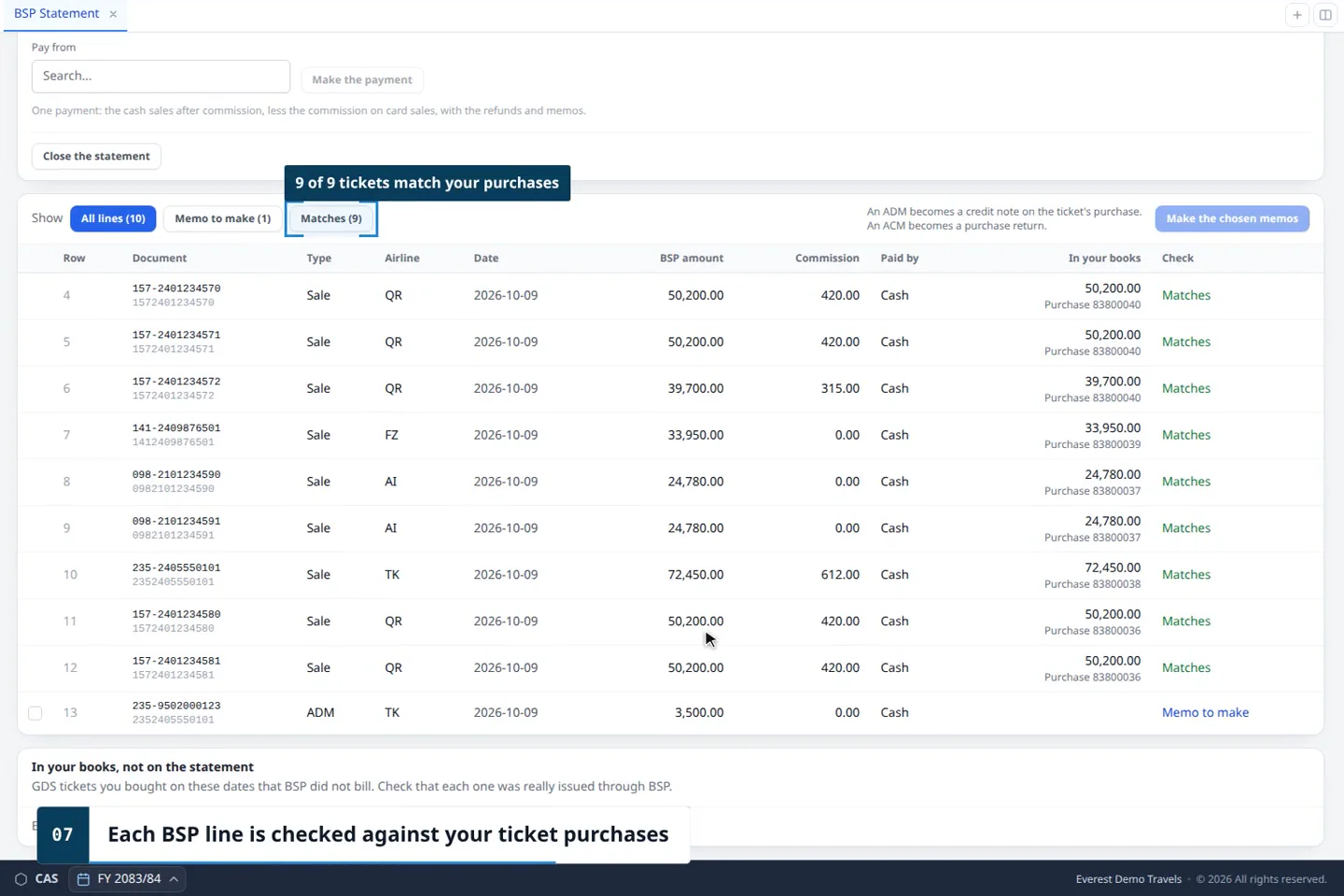
- Ticket Search finds a ticket by number or passenger and shows its sale, cost and margin.
- A product can post each airline to its own sales and purchase ledger.
- GDS import makes purchases you approve from Galileo (MIR) and Sabre (IUR) ticket files, not Amadeus (Enterprise plan; switched on for each company).
BSP is on every plan and is switched on for each company. We set it up with your first statement.
Read more about CAS360 for travel agencies, the Free plan and all plans and prices.
Questions
Questions about BSP reconciliation
How often should we check the BSP statement?
Every billing period, before the payment is due. At year end it is often too late to dispute a memo.
What is the difference between an ADM and an ACM?
An ADM (Agency Debit Memo) is the airline charging you more. An ACM (Agency Credit Memo) is the airline giving you money back.
Can we dispute an ADM?
Usually yes, through BSPlink, within your BSP's time limit. Keep the booking history and fare rules that support your case.
We buy tickets from a consolidator, not through BSP. Does this apply to us?
Yes. Check the consolidator's statement against your purchases in the same way.
Is the BSP check in CAS360 on the Free plan?
Yes, on request. Call or WhatsApp +977 9860274090 and we set it up with your first statement.